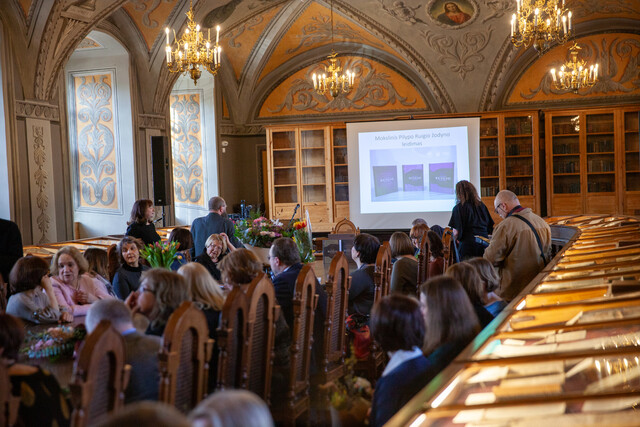
On March 6, the VU Library’s Franciszek Smuglewicz Hall hosted the presentation of the scholarly edition of Pilypas Ruigys’s dictionary.
Pilypas Ruigys’s book Littauisch–Deutsches und Deutsch–Littauisches Lexicon is the first Lithuanian–German and German–Lithuanian dictionary published in Prussian Lithuania. It was printed in 1747 in Königsberg at Johann Heinrich Hartung’s press.
Now, for the first time, it is being published for scholarly use and is therefore issued in three forms: Volume I consists of a facsimile; Volume II – a critical edition and study; Volume III – an index of Lithuanian words and a study.
At the same time, P. Ruigys himself was an outstanding figure of the Enlightenment. Descended from a family of Evangelical Lutheran pastors and a graduate of the University of Königsberg, he served as a pastor in Valtarkiemis from 1708 to 1749. The bilingual dictionary prepared there is one of the fundamental sources of Lithuanian studies, having influenced the development of the Lithuanian language, linguistics, and written culture.
Ruigys’s dictionary is particularly relevant to researchers of the written language: it is a work that presented mid 18th century norms of orthography, morphology, lexicon, and syntax, and further shaped the tradition of using the standard Lithuanian language in public life.
Participating in the event were the editors of the scholarly edition: Dr. (HP) Ona Aleknavičienė, Senior Research Fellow at the Institute of the Lithuanian Language’s Research Centre for Written Heritage, and Dr. Vilma Zubaitienė, Associate Professor at the Department of Lithuanian Language, Faculty of Philology, Vilnius University; the reviewer, Assoc. Prof. Dr. Žavinta Sidabraitė,
Senior Research Fellow at the Old Literature Department of the Institute of Lithuanian Literature and Folklore; the Dean of the VU Faculty of Philology, Prof. Dr. Mindaugas Kvietkauskas; and the Director of the Institute of the Lithuanian Language (LKI), Dr. Darius Ivoška.
The event was hosted by Assoc. Prof. Dr. Gintarė Judžentytė Šinkūnienė of the Department of Lithuanian Language (LKK).